Journal · Exhibitions & museums
What to see at the Centre Pompidou, Paris
The Centre Pompidou closed for renovation on 22 September 2025 and will not reopen in Paris until spring 2030. Its collection — 140,000 works, the largest of modern and contemporary art in Europe — is not in storage: selected pieces are touring through the Constellation program, from Centre Pompidou-Metz to the Grand Palais and beyond.
Closed until 2030 — what that means if you're planning a visit
The Centre Pompidou closed its doors on 22 September 2025 for a five-year renovation, with the building expected to reopen in spring 2030. The work is structural as much as curatorial: complete removal of asbestos from the façade, treatment of corrosion on the main structure, and upgrades to fire safety and accessibility. There is no partial access to the permanent collection at the Beaubourg building during this period.
The museum has not put the collection into storage for five years. Through what it calls the Constellation program, running from 2025 through 2030, selected works travel to other venues — Centre Pompidou-Metz, the Grand Palais and the Panthéon in Paris, the Grimaldi Forum in Monaco, and international partners including Centre Pompidou Málaga, Centre Pompidou Hanwha in Seoul, and the West Bund Museum in Shanghai. A new facility, Centre Pompidou Francilien, is set to open outside Paris in Massy in spring 2027, with exhibition and conservation space.
A collection built to be the largest of its kind in Europe
The museum's own figures put its holdings at 140,000 works, which the Centre Pompidou describes as the largest collection of modern and contemporary art in Europe. The works sit within the Musée National d'Art Moderne, spanning painting, sculpture, photography, and design from the early twentieth century into the twenty-first — the collection is built around the founding movements of that period, from Cubism and Surrealism through Abstract Expressionism and Pop.
The works the museum itself calls essential
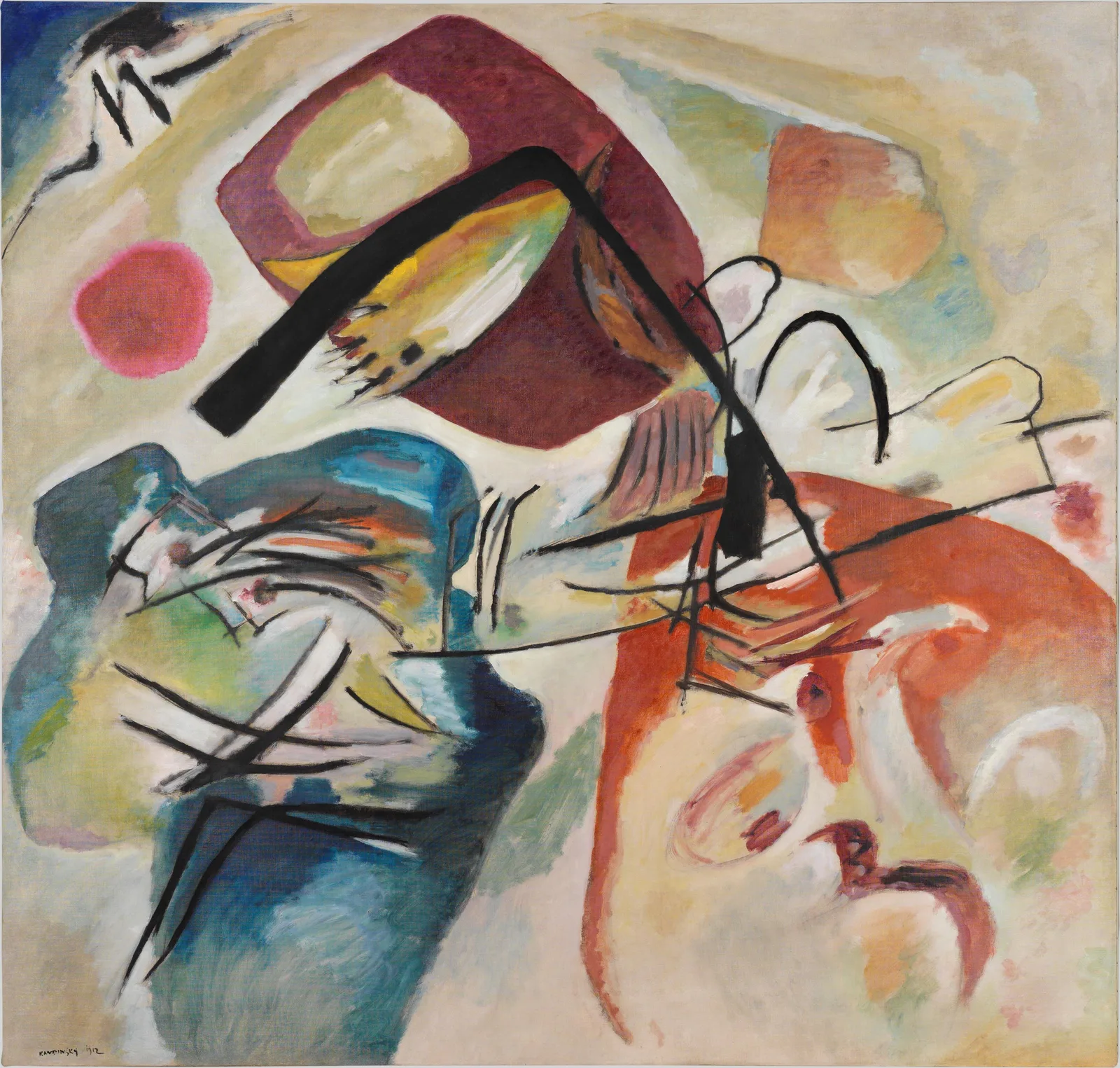
The Centre Pompidou's own "Masterpieces" selection names 22 works as the treasures of the collection, and several of them recur in almost every visitor's account of the building. Among them: Constantin Brancusi's La Muse endormie (1910), a polished bronze head reduced to a single continuous form; Vassily Kandinsky's Mit dem schwarzen Bogen ("With the Black Arc," 1912), an oil on canvas measuring 189 × 198 cm in which three colliding fields of red, blue, and violet-burgundy are held together by a single black arch; Marcel Duchamp's readymade Fontaine (1917/1964); Frida Kahlo's The Frame (1938); Piet Mondrian's New York City (1942); and Joan Miró's Bleu II (1961). Later works by Louise Bourgeois and Anselm Kiefer carry the same selection into the 1990s and 2010s.
Kandinsky's painting is a useful anchor for a first visit once the museum reopens: it was made in Munich in the autumn of 1912, shortly before the artist's exhibition at the Der Sturm gallery in Berlin, where he asked for this larger canvas to replace a smaller work already chosen. The black arch across the composition echoes the shape of a douga, the wooden shaft-bow from a Russian troika harness, placed exactly where the color fields collide.
The building competes with what's inside it
Designed by Renzo Piano and Richard Rogers and opened in 1977, the Centre Pompidou turns its structure inside out: air-conditioning ducts run blue, electrical systems yellow, water pipes green, and circulation elements — including the exterior escalator — red, all exposed rather than hidden behind a conventional façade. At 166 by 60 meters and ten levels of roughly 7,500 m² each, the building was conceived so every interior floor could be reconfigured, a fully modular museum rather than a fixed sequence of rooms.
From the studio
From the studio
I trained as an architect before I trained as a painter, so a building that puts its own structure on display — instead of hiding it behind a neutral wall — is not a curiosity to me, it's a familiar argument. The Centre Pompidou says a museum can be honest about how it's held together and still hold the art. That's close to how I think about a canvas leaving my studio: the sculpted relief, the raw edge, the visible layer under the gold leaf — none of it is disguised as something smoother than it is.
I have not been able to see the Kandinsky in person, and I won't pretend otherwise. But the discipline in that painting — three colors forced into tension and then held by one deliberate line — is the same discipline I ask of a large canvas: nothing extra, one decision doing the work of ten. For collectors reading this from outside Brazil, that's also the practical note — the studio ships internationally, sells directly without a gallery in between, and every piece leaves with a signed Certificate of Authenticity and an internal Archive ID, the same instinct toward documentation that keeps a public collection legible a century later.
Frequently asked
Is the Centre Pompidou closed for renovation — should you check before visiting?
Yes. The Centre Pompidou closed on 22 September 2025 for a five-year renovation and is not expected to reopen in Paris until spring 2030. If you are planning a trip before then, check the museum's official site for which works are showing at partner venues through its Constellation program rather than assuming the Beaubourg building is open.
How much time do you need for the Centre Pompidou's permanent collection?
Once the museum reopens in 2030, budget two to three hours to see the works the museum itself highlights as essential — pieces by Kandinsky, Brancusi, Duchamp, Kahlo, Mondrian, and Miro among them — and longer if you want to follow the collection chronologically through its full twentieth- and twenty-first-century span. Until the reopening, this estimate does not apply to the Beaubourg building, since it is closed; each Constellation venue has its own separate visiting time.
What is the Centre Pompidou's collection focused on?
It centers on modern and contemporary art from the early twentieth century onward — around 140,000 works in total, spanning painting, sculpture, photography, and design, and covering the collection's core movements from Cubism and Surrealism through Abstract Expressionism and Pop.
Is the Centre Pompidou more about the architecture or the art?
Both, by design. The building itself, designed by Renzo Piano and Richard Rogers and opened in 1977, exposes its structural and mechanical systems on the exterior in a deliberate departure from a conventional museum facade. Visitors routinely cite the building alongside the art as a reason to go.
How does the Centre Pompidou compare to MoMA in New York?
Both are major public collections of modern and contemporary art with international reach, but they differ in building and approach: MoMA occupies a more conventional museum structure in midtown Manhattan, while the Centre Pompidou is defined by its inside-out architecture. Neither museum's official materials publish a direct size comparison between the two collections, so architecture and curatorial framing, rather than a size claim, are the meaningful points of contrast.
Where can you see Centre Pompidou-owned works while the main building is closed?
Through the Constellation program, works are on view at Centre Pompidou-Metz, the Grand Palais and the Pantheon in Paris, the Grimaldi Forum in Monaco, and international partner venues including Centre Pompidou Malaga, Centre Pompidou Hanwha in Seoul, and the West Bund Museum in Shanghai, among others.
Sources
- Centre Pompidou (official site) — 2026-08-23
- Centre Pompidou (official site) — 2026-08-23
- Centre Pompidou (official site) — 2026-08-23
- Centre Pompidou (official site) — 2026-08-23
- Wikimedia Commons — 2026-08-23
Planning an art trip to Paris?
If the Centre Pompidou's architecture-meets-art approach speaks to you, the studio is glad to walk you through the Perfeito Studio collection — works conceived at architectural scale, shipped internationally, acquired directly from the artist.
Talk to the studio on WhatsApp
Published on