Journal · Exhibitions & museums
What to see at the Prado Museum, Madrid
For a first visit, prioritize four works: Velázquez's Las Meninas, Bosch's The Garden of Earthly Delights, Goya's The Third of May 1808, and van der Weyden's The Descent from the Cross. Together they cover four centuries and three schools of painting, Spanish, Netherlandish, and Flemish, inside the Museo del Prado's permanent collection.
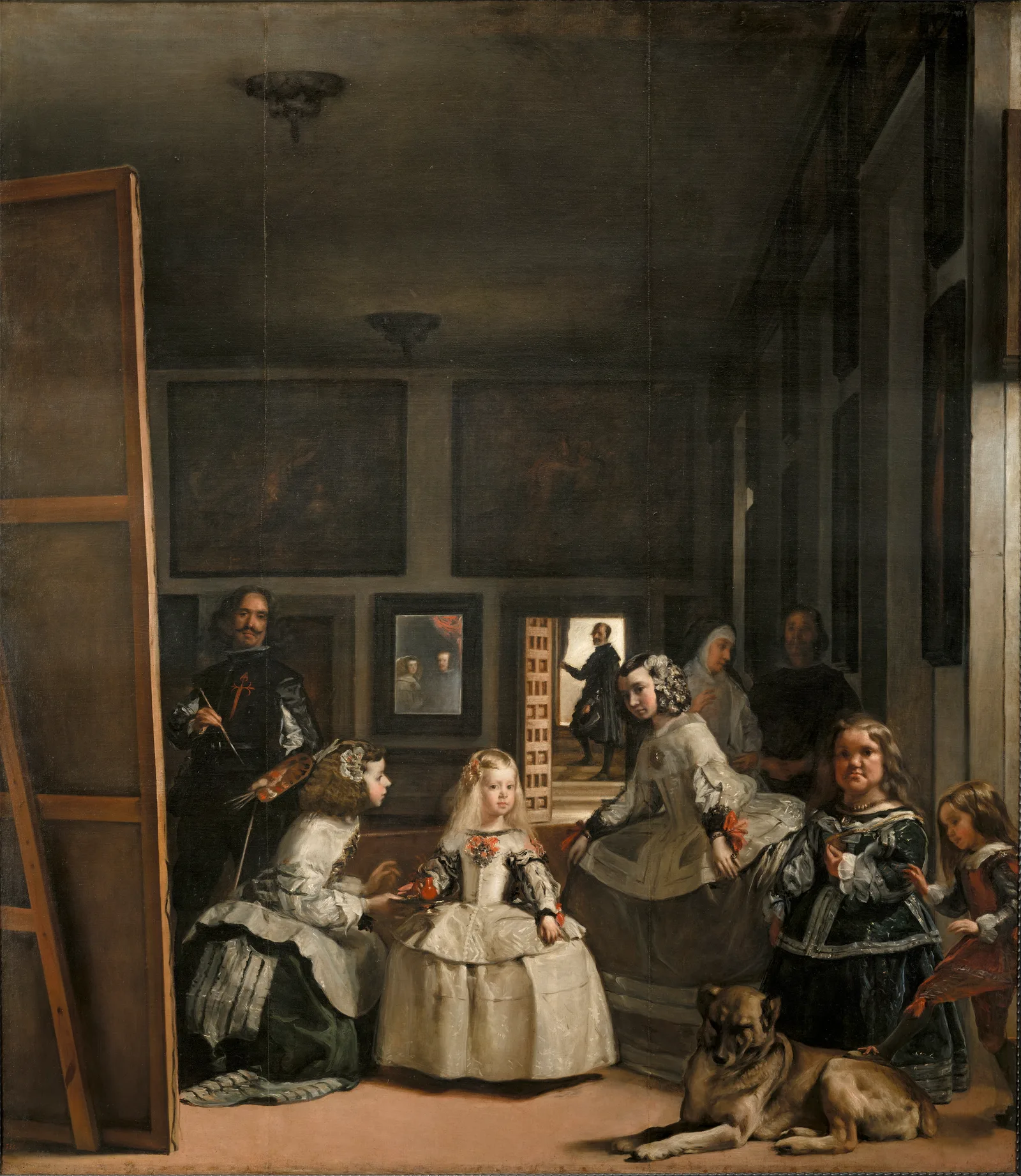
Velázquez's Las Meninas: the painting the Prado is built around
Diego Velázquez painted Las Meninas in 1656, in oil on canvas measuring roughly 320.3 by 279.1 centimeters. It is catalogued in the Prado's permanent collection under inventory number P001174, and has never lost its status as Velázquez's central achievement: writer Antonio Palomino gave it its own chapter in his 1724 history of Spanish painters, the only work he treated that way.
The composition places Velázquez himself at the left, palette in hand, painting a portrait of King Philip IV and his queen, whose reflection appears in a mirror at the back of the room. At the center stands the young Infanta Margarita, attended by her meninas, with two court dwarfs, Mari Bárbola and Nicolasico Pertusato, and a dog at the right. It is a portrait, a self-portrait, and a picture about the act of painting, all held inside a single room.
Bosch's The Garden of Earthly Delights: the triptych that rewards slow looking
Hieronymus Bosch, born and based in s'Hertogenbosch in the Netherlands (c. 1450 to 1516), painted this triptych between 1490 and 1500 in oil and grisaille on oak panel. The work stands 185.8 centimeters tall, with a central panel 172.5 centimeters wide and two folding wings of 76.5 centimeters each, catalogued under inventory number P002823.
Philip II purchased the triptych in 1591 and sent it to the Monastery of San Lorenzo de El Escorial two years later. It arrived at the Prado in 1933 for restoration and has remained part of the museum's collection since 1939, on permanent loan from Patrimonio Nacional. Closed, the exterior grisaille shows the earth on the third day of Creation; opened, the three panels move from Eden to a crowded garden of pleasure to a nightmare of punishment, a sequence built for a viewer who is expected to look for a long time, not once.
Goya's The Third of May 1808: history painting turned into protest
Francisco de Goya y Lucientes (Fuendetodos, Zaragoza, 1746, to Bordeaux, 1828) painted this canvas in 1814, oil on canvas, 347 by 268 centimeters, inventory number P000749. Goya composed it around the return of King Ferdinand VII to Madrid, commemorating the uprising of 2 May 1808 against the French occupation and the executions that followed that night. It forms a pair with The 2nd of May 1808 in Madrid, or the Fight against the Mamelukes, also in the Prado's collection.
Where earlier battle painting tends to celebrate command and strategy, Goya's canvas puts a single anonymous man in a white shirt in front of a firing squad, arms raised, no general in sight. It is one of the works most frequently cited as the origin point for painting war from the side of its victims rather than its commanders.
Van der Weyden's The Descent from the Cross: the Prado's Flemish anchor
Rogier van der Weyden, born in Tournai and active in Brussels (1399 to 1464), painted this panel before 1443 in oil on panel, 204.5 by 259 centimeters, inventory number P002825. Originally made for a chapel in Leuven, it was later acquired by Mary of Hungary and brought to Spain, where it was kept at the Monastery of El Escorial since the sixteenth century until 1936, when it moved to the Prado, where it remains on permanent loan from Patrimonio Nacional.
Ten figures, carved-looking rather than merely painted, are compressed into a shallow gilded box that imitates a sculpted altarpiece shrine. The body of Christ is lowered by Joseph of Arimathea and Nicodemus in a curve that echoes the collapsing figure of the Virgin below it, one of the most studied compositions in early Netherlandish painting.
The Prado's scope goes beyond Spanish painting
Velázquez and Goya are Spanish, but Bosch and van der Weyden are not, and neither are large parts of the collection built up by Spain's Habsburg rulers, who acquired Italian, Netherlandish, and Flemish painting on the same scale as they patronized their own court painters. A first visit built around these four works already crosses three centuries, two languages of painting, and three countries of origin, before ever reaching the museum's later Spanish and Italian rooms.
From the studio
The studio's eye: reading Las Meninas as a problem of scale
Studying reproductions of Las Meninas is a recurring exercise in the studio, not for the palette but for the geometry. Velázquez builds an entire room around a single, off-center vanishing point, then sets a mirror at the back of it, so the viewer's own position becomes part of the composition. That is close to the problem I return to as an architect painting at scale: where does a body stand relative to the canvas, and what does the surface do to that distance. In Amber Strata, the horizontal build of pigment is meant to be walked past, not just faced head-on, a slower read that only works if the scale of the room and the scale of the canvas are considered together, the way Velázquez considered the room he painted himself into, easel half-visible at the edge of his own picture.
Frequently asked
What is the Prado Museum most famous for?
The Prado is best known as the home of the Spanish royal collection, assembled by the Habsburg and Bourbon kings over three centuries. Its single most famous work is Velázquez's Las Meninas, painted in 1656 and held in the museum's permanent collection under inventory number P001174. Beyond Velázquez, the museum is equally known for Francisco Goya, represented by dozens of paintings including The Third of May 1808, and for major Netherlandish and Flemish holdings such as Hieronymus Bosch's The Garden of Earthly Delights, a legacy of Habsburg collecting well beyond Spain's own borders.
How much time do you need to see the Prado's highlights?
Seeing the four works covered in this guide attentively, Las Meninas, The Garden of Earthly Delights, The Third of May 1808, and The Descent from the Cross, realistically takes two to three hours, including the walk between galleries and a few minutes standing in front of each. The Prado's painting collection is large enough that a single visit rarely covers everything. Most visitors treat a first pass as a focused route through the essentials, then save a second visit for the rest of the Golden Age galleries.
Does the Prado focus on Spanish painters only?
No. While Diego Velázquez and Francisco Goya anchor the collection, the Prado also holds major non-Spanish works acquired by Spain's Habsburg rulers, who collected broadly across Europe. Hieronymus Bosch, born and based in s'Hertogenbosch in the Netherlands, and Rogier van der Weyden, born in Tournai and active in Brussels, both in present-day Belgium, are represented by some of their most significant paintings, including The Garden of Earthly Delights and The Descent from the Cross. Italian and other Flemish masters from the royal collections extend that range further.
Is the Prado better paired with the Reina Sofía or the Thyssen-Bornemisza?
It depends on what a first Prado visit is missing. A 1995 Spanish Royal Decree set Pablo Picasso's birth year, 1881, as the dividing line between the Prado and the Reina Sofía, so anyone wanting to see Picasso's Guernica, held at the Reina Sofía since 1992, needs a separate stop. The Thyssen-Bornemisza, with close to a thousand paintings spanning the late 13th to the 20th century, works better as a bridge, filling in Impressionism, German Expressionism, and other movements the Prado's older collection does not cover.
Is photography allowed inside the Prado?
No. According to the museum's own regulations, photography or filming inside the galleries is not permitted. The rule applies across the permanent collection, including wherever Las Meninas and the other works in this guide are displayed, and is enforced consistently rather than left to individual attendants' discretion. Visitors who want to document a visit are better served by the Prado's own image archive and shop for reproductions than by photographing the paintings directly.
Sources
- Museo Nacional del Prado — 2026-08-08
- Museo Nacional del Prado — 2026-08-08
- Museo Nacional del Prado — 2026-08-08
- Museo Nacional del Prado — 2026-08-08
- Museo Nacional del Prado — 2026-08-08
- Museo Nacional Centro de Arte Reina Sofía — 2026-08-08
- Museo Nacional Thyssen-Bornemisza — 2026-08-08
- Wikimedia Commons (photograph credited to Museo Nacional del Prado's online gallery) — 2026-08-08
Bring that same eye home
If a room built around Las Meninas is what convinces you that scale and composition matter, Perfeito Studio's architecturally-scaled originals are designed with the same discipline, for collectors and interiors anywhere in the world.
Talk to the studio on WhatsApp
Published on