Journal · Exhibitions & museums
What to see at the Van Gogh Museum, Amsterdam
The Van Gogh Museum in Amsterdam holds the world's largest Van Gogh collection -- around 200 paintings, including Sunflowers, The Bedroom, and Almond Blossom -- but not The Starry Night, which has been at MoMA in New York since 1941. Sunflowers and the self-portrait rooms are the fastest route through the collection's real center.
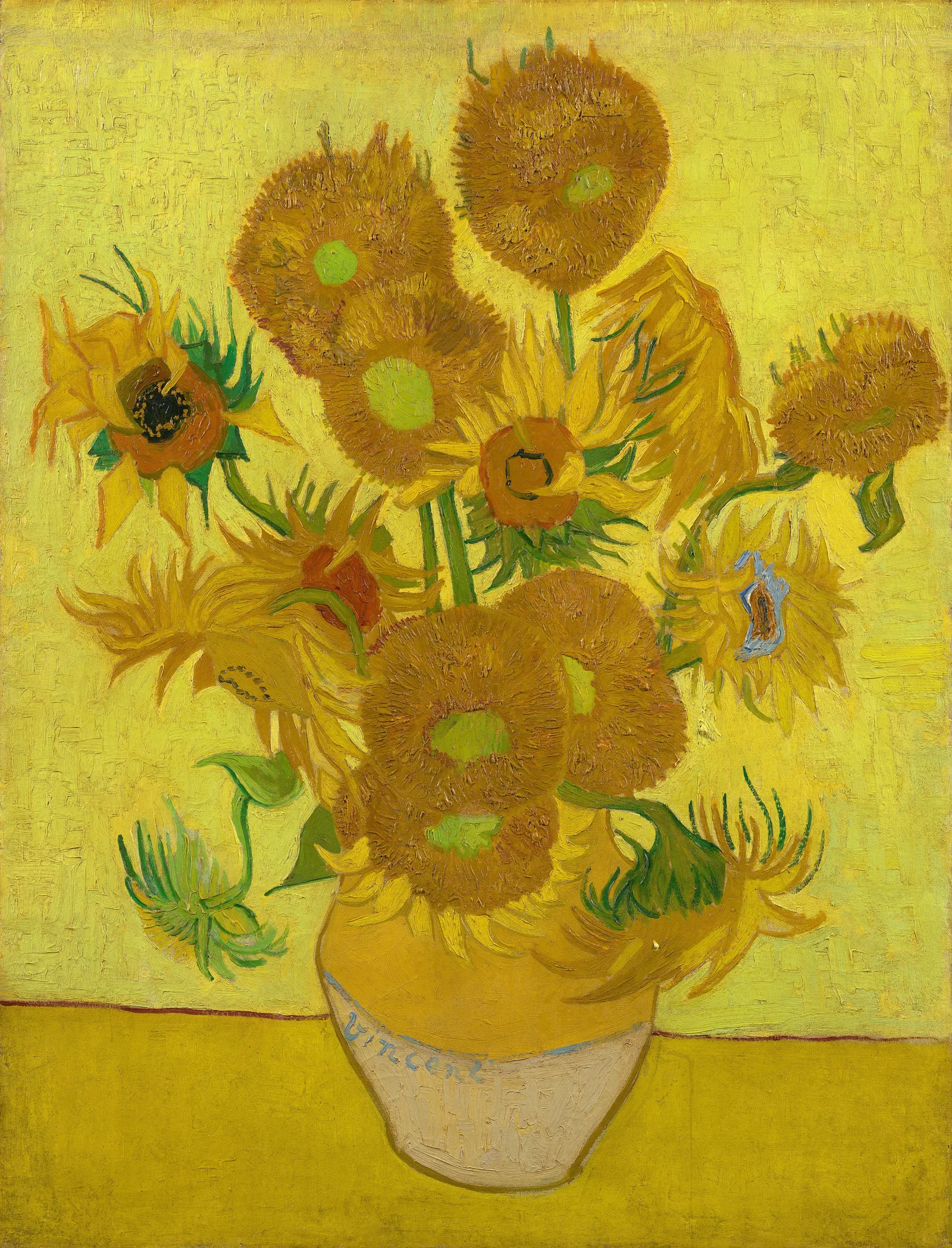
The works that define the collection, and what to look at
The core of the Van Gogh Museum's holdings sits in a small group of paintings from 1888 to 1890: Sunflowers (August 1889, held under museum inventory s0031V1962), The Bedroom (1888), Almond Blossom (1890), and The Potato Eaters (1885) -- plus a run of self-portraits shown together, letting visitors trace how his brushwork changed across a single decade of work.
Look closely at Sunflowers first: the petals are built from paint laid on thick and dry, almost sculpted, while the background stays flat and matte -- a contrast between raised texture and quiet ground that recurs across the collection. Almond Blossom, painted for his newborn nephew while Van Gogh was at Saint-Rémy, works the opposite way: thin, controlled outlines against a flat blue sky, closer to the Japanese prints he collected than to the loaded impasto of the sunflowers a year earlier.
Is The Starry Night at the Van Gogh Museum? What's actually here
No -- The Starry Night is not in Amsterdam. Van Gogh's most reproduced painting has been in the permanent collection of the Museum of Modern Art in New York since 1941, acquired through the Lillie P. Bliss Bequest. It is the single most common misconception visitors bring to the Van Gogh Museum, and worth clearing up before arrival so the visit is not spent looking for a painting that lives on another continent.
What the Amsterdam museum holds instead, from the same and adjacent years, still traces the arc that produced The Starry Night: the thick, directional brushwork of Sunflowers, the controlled color fields of Almond Blossom, and the self-portraits that register the same restless hand. The museum also holds roughly 400 drawings and about 700 letters -- the working notebook behind the paintings, in the artist's own words.
Van Gogh Museum vs. Rijksmuseum -- two different visits
The two museums sit a short walk apart in Amsterdam's Museum Quarter and answer different questions. The Van Gogh Museum, opened in 1973, is a monographic museum built around a single artist -- its entire program is the life and development of one painter, told largely in chronological order. The Rijksmuseum is the national museum of the Netherlands, built to tell the story of Dutch art and history across eight centuries, with Van Gogh appearing only as one name among many.
In practice: choose the Van Gogh Museum for a focused, two-hour encounter with one artist's full arc. Choose the Rijksmuseum for Rembrandt, Vermeer, and the broader sweep of Dutch painting -- a longer visit, and a different kind of attention. Visitors who want both usually plan the Van Gogh Museum first, before the historical range of the Rijksmuseum widens the frame.
Planning the visit: how long you need, and Van Gogh in his own words
Most visitors budget around two hours for the Van Gogh Museum's core rooms -- enough time for Sunflowers, The Bedroom, Almond Blossom, the self-portrait wall, and a slower pass through the late Auvers-sur-Oise paintings from his final months. That is roughly half the time the larger, more encyclopedic Rijksmuseum asks for.
Budget extra time for the letters. The museum's holdings include around 700 letters, most written to his brother Theo, and the permanent exhibition places excerpts from them alongside the paintings -- giving the collection a running first-person narration that most single-artist museums don't attempt. Reading even a handful of these passages next to the paintings they describe changes how the brushwork reads.
From the studio
The studio's eye
I keep coming back to how thick Van Gogh lays the paint in Sunflowers -- petals built up until they hold real shadow, while the ground around them stays flat and quiet. It's the same decision I make with the texture paste in Golden Passage and the other Black & Gold pieces: where the surface gets to stand up and catch light, and where it goes still. Gold leaf does a version of the same work as his impasto -- both refuse to just be color, they insist on being matter you can feel from across a room.
What I notice more, though, is the self-portrait wall. Ten years of the same face, painted in a different hand each time, is the clearest record I know of an artist finding a language -- which is exactly what I'm doing across Heart of Chaos, Terra & Ether, and the other series: not one statement, but a body of work that keeps testing the same questions from a new angle.
Frequently asked
What is the Van Gogh Museum's collection focused on?
The Van Gogh Museum in Amsterdam holds the world's largest collection of Vincent van Gogh's work -- around 200 paintings, 400 drawings, and 700 letters. Unlike a general art museum, it is monographic: every gallery traces a single artist's development, from his early Dutch period through Arles, Saint-Remy, and Auvers-sur-Oise. Highlights include Sunflowers, The Bedroom, Almond Blossom, The Potato Eaters, and a wall of self-portraits.
Is the Starry Night at the Van Gogh Museum in Amsterdam?
No. The Starry Night has been in the permanent collection of the Museum of Modern Art in New York since 1941, acquired through the Lillie P. Bliss Bequest -- it has never hung in Amsterdam. This is the single most common misconception about the Van Gogh Museum. What the Amsterdam museum does hold, from the same period of Van Gogh's life, includes Sunflowers, Almond Blossom, and a substantial group of self-portraits and letters.
How is the Van Gogh Museum different from the Rijksmuseum?
The Van Gogh Museum, opened in 1973, is dedicated entirely to one artist and tells his story chronologically across a single, focused visit. The Rijksmuseum is the national museum of the Netherlands, covering eight centuries of Dutch art and history -- Rembrandt, Vermeer, decorative arts, and far more ground than one painter's career. They sit a short walk apart in Amsterdam's Museum Quarter, and most visitors treat them as two separate visits rather than one combined afternoon.
How much time do you need for the Van Gogh Museum?
Around two hours covers the core of the collection at a comfortable pace: Sunflowers, The Bedroom, Almond Blossom, the self-portrait wall, and the late paintings from Auvers-sur-Oise. That is roughly half the time typically recommended for the larger Rijksmuseum nearby. Visitors who also want to read through a selection of Van Gogh's letters, which the permanent exhibition places alongside the paintings, should plan for closer to three hours.
Does the Van Gogh Museum show his letters as well as his paintings?
Yes. The museum holds roughly 700 letters Van Gogh wrote, most of them to his brother Theo, alongside its paintings and drawings. The permanent exhibition places excerpts from these letters in the same galleries as the paintings they describe, giving visitors the artist's own account of works like Sunflowers and Almond Blossom. It is one of the features that sets the museum apart from a conventional single-artist retrospective.
Sources
- Wikipedia — 2026-08-22
- Wikipedia — 2026-08-22
- Wikimedia Commons — 2026-08-22
Bringing texture and gold leaf into your own space?
Talk to the studio about the Black & Gold and Terra & Ether series -- works built with the same instinct for material weight that draws people to Van Gogh's impasto.
Talk to the studio on WhatsApp
Published on