Large abstract art for a dining room
For a dining room, choose a piece sized to the sideboard or the nearest open wall, not the table below it, at roughly two-thirds of that furniture's width, hung 15 to 20 cm above it. Whether the piece should be bold or subdued has less to do with convention than with how the room is lit after dark.
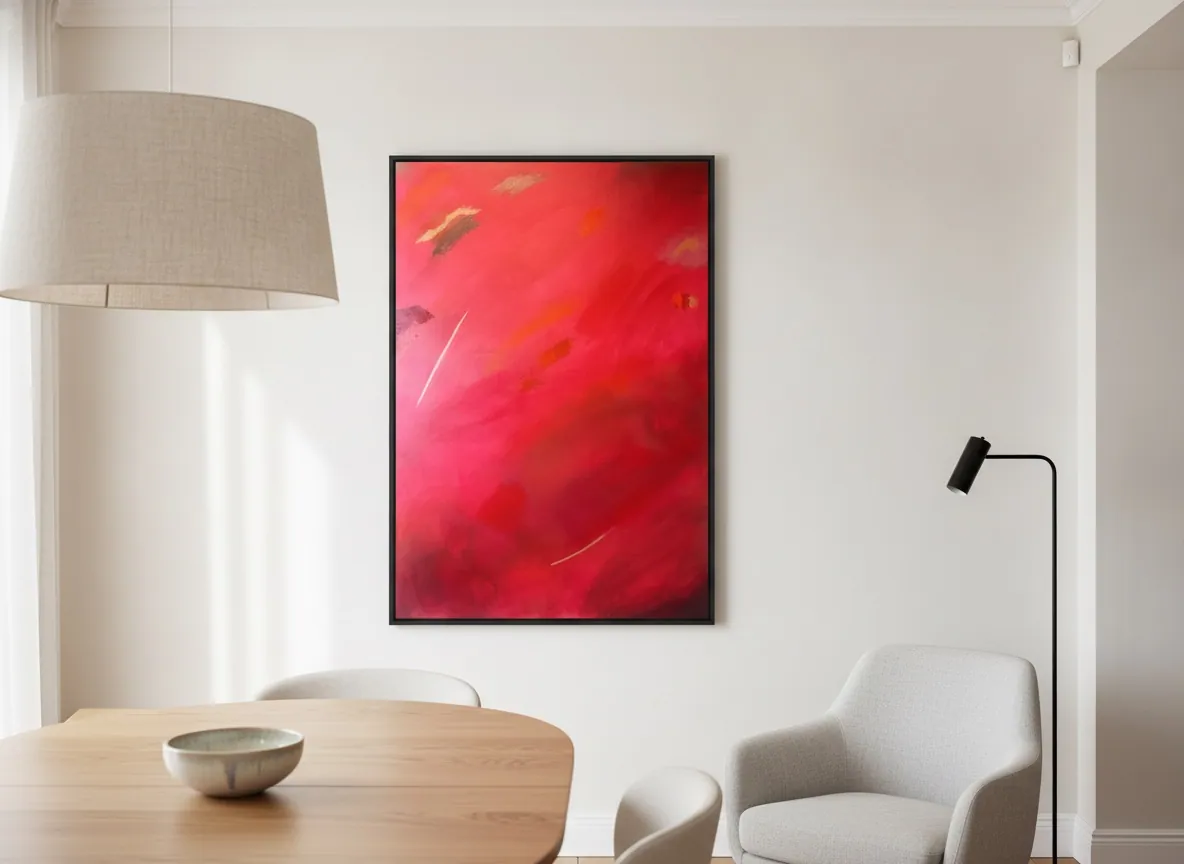
Sizing it to the sideboard, not the table
A dining room is usually a smaller, more interrupted wall than a living room's — broken by a doorway, a window, or a sideboard that already claims part of it. The furniture that anchors the room, not the table, is what a painting should be sized against.
- Above a sideboard or console (1.6–2.2 m long): aim for a painting roughly two-thirds of that length — around 100–150 cm wide — leaving the piece room to breathe on both sides rather than running edge to edge.
- On an open wall the table faces, with no sideboard below: scale to the wall itself, keeping generous margin on either side; a narrow wall reads better with a vertical format than a wide horizontal one forced to fit.
- Formal dining rooms with higher ceilings: a single large-format piece, from around 100 × 150 cm up, tends to hold the wall better than two smaller works, since dining rooms rarely have the depth for a gallery-style grouping.
Fire of Devotion, at 100 × 150 cm, sits close to the upper end of that range — proportioned for a sideboard wall in a room with real ceiling height, rather than a narrow breakfast nook.
Bold color or something more restrained
A dining room is read under two different kinds of light within the same day, and that matters more for color choice than any styling rule. At a Sunday lunch, daylight is flat and even; at a dinner party, the same wall sits under a chandelier, pendant lamp or candlelight, and color intensifies.
- Rooms used mostly at night, for dinners and entertaining: a saturated, high-contrast piece carries well — warm artificial light already lifts the room's intensity, and a bold red or gold-flecked surface answers it rather than fighting it.
- Rooms used daily, for breakfast and everyday meals: something quieter tends to wear better over time, since the painting is seen at length, morning after morning, rather than in a single evening's mood.
- Mixed-use rooms: a piece with both a strong field of color and passages of restraint — rather than pure maximalism — tends to hold up across both contexts.
This is less a rule about taste than about how many hours a day the room, and the painting in it, actually gets looked at.
Does abstract art suit a formal dining room
Yes, though the question carries an old assumption worth naming: that formality in a dining room comes from ornament — gilt frames, still-life paintings, matched sets. Abstraction earns formality differently, through scale, material and restraint rather than subject matter.
A single strong abstract painting, well sized to the wall, often reads as more considered in a formal room than a smaller decorative print, because it behaves as the room's one deliberate gesture instead of competing with china, linen and silverware for attention. Mixed-media surfaces with sculpted texture or gold leaf carry a material weight that a flat print cannot — under the varied light of a dining room, that surface catches and shifts, which is closer to how a formal room is meant to feel than something static.
What doesn't work as well: something busy or narrative hung where guests are meant to be talking to each other, not decoding a scene.
Where to hang it — and why not over the table itself
Center the painting so its middle lands close to seated eye level — roughly 145–155 cm from the floor in most rooms — since a dining room is experienced from a chair, not standing. Above a sideboard, leave 15–25 cm between the top of the furniture and the bottom of the frame, the same margin that works above a sofa or console elsewhere in the home.
Hanging the piece directly above the table itself is usually the wrong move, for a practical reason before an aesthetic one: overhead pendant lights and chandeliers throw glare across a painting hung that low and that close to the light source, and the piece ends up competing with whatever is set on the table for the eye's attention. A sideboard wall, an end wall the table faces, or the wall guests see when seated tends to serve the room better than the space directly over the place settings.
Buying it directly from the studio, and what travels with it
Every work leaves Perfeito Studio the same way: acquired directly from the artist, with no gallery or intermediary in between. The conversation happens over WhatsApp, and the piece arrives with a signed Certificate of Authenticity, an artist dossier covering the series and technical data, and an internal Archive ID that registers the work permanently in the studio's records.
International shipping is quoted per destination once a piece is chosen. Large-format canvases can travel either stretched on their frame, for domestic delivery, or carefully rolled and protected for international transit, then re-stretched on arrival — which option applies depends on size and destination, and is confirmed before anything ships. None of this changes because the buyer is choosing a piece for a dining room specifically; it's the same process for any room in the house.
From the studio
From the studio
I trained as an architect before I trained as a painter, and dining rooms are where that shows up most in how I think about scale. A living room is read from a distance, across a sofa; a dining room is read from a chair, at a fixed height, by people who are mostly looking at each other and only glance at the wall between courses. That changes what the painting needs to do — it has to reward a short look, not hold attention for an hour.
It's also the room in the house where I think hardest about light changing across a single day. A piece like Fire of Devotion carries flecks of gold and copper through a field of red, and I built those in knowing they would catch differently at a Sunday lunch than at a dinner lit by candles — flat and matte under daylight, then sudden and warm once the light source gets low and close, the way it does over a table at night. I don't paint for one lighting condition. For a dining room especially, I paint for both.
Frequently asked
What size painting works above a dining table?
A painting hung above a dining sideboard or console should run roughly two-thirds of that furniture's width, the same proportion used above a sofa. For a 1.6 to 2 m sideboard, that puts the painting around 100 to 140 cm wide. Where there is no sideboard and the piece hangs on open wall facing the table, scale it to the wall itself, leaving generous margin on both sides rather than filling it edge to edge.
Should dining room art be bold or subdued?
It depends on how the room is used. A dining room seen mostly at night, under a chandelier or pendant light, can carry a saturated, high-contrast piece well, since warm artificial light already raises the room's intensity. A room used daily for breakfast under flat daylight tends to live better with something quieter, since the art is seen at length rather than in a single evening moment.
Does abstract art work well in a formal dining room?
Yes. Formality in a dining room has traditionally come from ornament, symmetry and representational art, but abstraction can carry the same weight through scale, material and restraint. A single strong abstract piece often reads as more considered than a smaller decorative print, because it behaves as the room's one deliberate gesture rather than competing with the table setting for attention.
How high should art hang in a dining room?
Center the painting so its middle sits close to seated eye level, generally 145 to 155 cm from the floor, and leave 15 to 25 cm between the top of a sideboard and the bottom of the frame. Hanging art directly above the table itself is usually avoided, since overhead pendant lights tend to throw glare across the surface and the piece competes with whatever is on the table.
Can the same piece work for both dining and entertaining?
Often, yes, particularly in open-plan homes where dining and living areas share one continuous sightline. What matters is that the piece reads well at both the closer range of the dining table and the longer range of a sofa or entertaining area, which favors a larger format with texture and layering that hold up at both distances rather than a small, detail-driven piece.
Can I buy directly from the artist, and does it ship internationally?
Yes. Every work is acquired directly from the artist's studio, with no gallery intermediary, and includes a signed Certificate of Authenticity, an artist dossier and an internal Archive ID. International shipping is quoted per destination, with large canvases shipped either stretched or carefully rolled and re-stretched on arrival, depending on size and destination.
Not sure what fits your dining room?
Send a photo of the wall and the table or sideboard's measurements, and we will tell you what fits before any purchase decision.
Talk to the studio on WhatsApp
Published on