The Scream by Edvard Munch, explained
The Scream exists in four original versions by Edvard Munch, painted between 1893 and 1910. The best-known version, a tempera and crayon work on cardboard from 1893, hangs in Room 060 of the National Museum (Nasjonalmuseet) in Oslo, where it has remained on near-continuous public display since entering the collection in 1910.
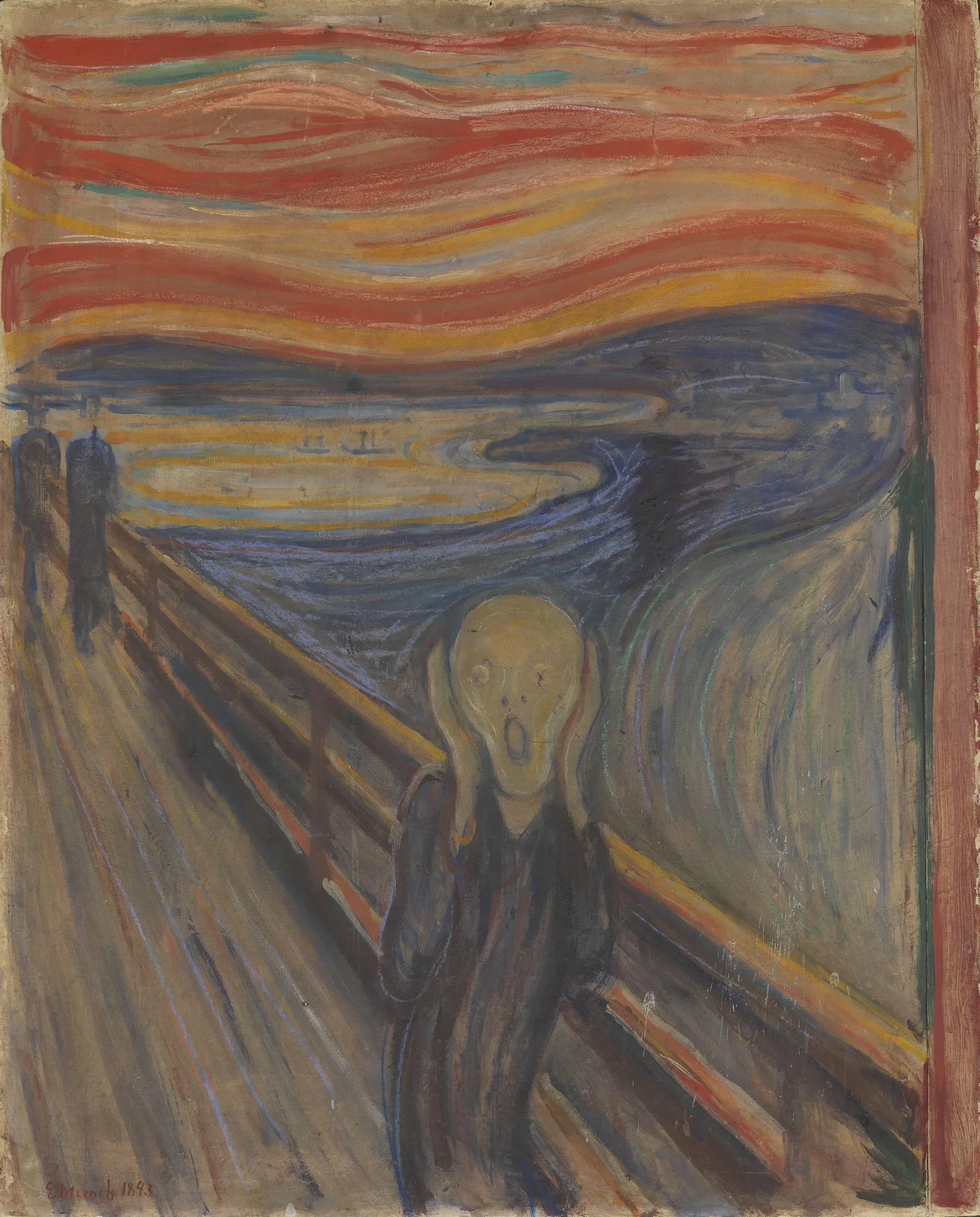
Where the original hangs today
The version of The Scream most people picture — the one reproduced on posters, mugs, and emoji — is a tempera and grease-crayon painting on cardboard that Munch made in 1893. It measures 91 x 73.5 cm and has belonged to Norway's National Museum (Nasjonalmuseet) since the museum acquired it in 1910, catalogued under accession number NG.M.00939.
Aside from stretches when it traveled on loan to other institutions, the painting has remained on public view in Oslo since it entered the collection. Today it hangs in Room 060 of the museum's permanent galleries, in the section devoted to Edvard Munch.
Four originals, not one
Munch did not paint The Scream once. He returned to the composition four times between 1893 and 1910: a pastel and a tempera painting in 1893 (the tempera is the Oslo version described above; the 1893 pastel belongs to the Munch Museum), a second pastel in 1895, and a tempera painting in 1910, also held by the Munch Museum. Each version differs slightly in color and handling, but the composition — bridge, figure, blood-red sky — stays constant across all four.
Munch also translated the image into print. He made a lithograph of The Scream in 1895; the Munch Museum estimates that roughly 30 impressions survive today, six of them in the museum's own holdings, including one that Munch hand-colored himself.
The scream comes from nature, not the figure
The figure at the center — hairless, genderless, hands pressed to a skull-like face — is often read as a person screaming. Munch's own account suggests the opposite. In an 1892 diary entry describing a walk with two friends near Oslo at sunset, he wrote that the sky "turned blood red," that he stopped, trembling, and that he "sensed an infinite scream passing through nature." The figure, in his telling, is not producing the scream; it is reacting to one it hears coming from the landscape itself.
One popular theory ties the blood-red sky to the 1883 eruption of Krakatoa, whose ash famously tinted sunsets red across the Northern Hemisphere for months afterward. Historians who study Munch's work dispute the connection, pointing out that he was not a literal, observational painter and rarely worked from a single documentary source.
Tempera and crayon: how the sky keeps moving
The materials matter as much as the image. Nasjonalmuseet's own catalogue entry lists the Oslo painting's medium as tempera and grease crayon on cardboard — a combination that dries fast and resists correction, which pushes toward long, committed strokes rather than layered, reworked ones.
That shows in the sky. The same curving line that shapes the clouds continues, almost without a break, into the fjord below and the railing the figure grips — the whole surface behaves as one continuous gesture rather than a scene built from separate, describable parts. Munch put the effect in blunt terms of his own: "The color shrieked."
Stolen twice — two different paintings
The Scream has been stolen from a Norwegian museum twice, a decade apart, and the two incidents involved two different works. On 12 February 1994, thieves broke into the National Gallery in Oslo — predecessor of today's National Museum — and cut the 1893 tempera version from its mount. It was recovered undamaged on 7 May 1994, after a police sting operation, and returned to display.
A decade later, on 22 August 2004, masked gunmen stole the 1910 tempera version and Munch's Madonna from the Munch Museum in broad daylight. Both paintings were recovered in 2006; researchers who later examined the Scream found water damage in its lower left corner, sustained during the two years it was missing. The painting on view in Oslo today, discussed above, is not the one that suffered that damage — it is the version stolen and recovered undamaged in 1994.
A third version entered the market rather than a police file: in May 2012, a 1895 pastel consigned by the Olsen family sold at Sotheby's in New York for US$119,922,500, then the highest price ever paid for an artwork at public auction. That pastel had never hung in a museum and is not the painting Oslo visitors see today.
From the studio
What a single unbroken line has to do with my own canvases
I've never stood in front of the Oslo Scream, and almost no one reading this has either — everything most of us know of it comes from reproduction. What the museum's own description gets right, though, is the thing a screen flattens: that sky is not built from separate marks. It's one continuous curving line that keeps going through the water and the railing, so the whole surface moves together instead of breaking into a sky, a fjord, and a figure that happen to share a canvas.
That's close to what I chase in Silent Interval. The black line that runs down that canvas isn't a series of separate strokes either — it thickens, thins, scatters into a fine spray of droplets, and finally settles into one weighted pool, all as a single unbroken movement. I don't paint it in pieces and I don't correct it afterward; either the line holds the whole gesture or it doesn't. Munch's sky and my line are after different things — his is anguish, mine is closer to restraint — but the technical demand is the same: let one continuous mark carry more feeling than a dozen careful ones would.
Frequently asked
Where is the original version of The Scream located today?
The most widely reproduced version, a tempera and grease-crayon painting from 1893, has been part of the National Museum (Nasjonalmuseet) in Oslo since 1910. It is catalogued under accession number NG.M.00939 and hangs in Room 060 of the museum's permanent galleries, in the section devoted to Edvard Munch. Aside from occasional loans elsewhere, the painting has remained on public display there since it entered the collection. Munch made three other original versions of the same composition, held in different collections, so 'the original' more precisely means the first and most famous of four.
How many versions of The Scream did Munch paint?
Munch made four original versions of The Scream between 1893 and 1910: a pastel and a tempera painting from 1893, now split between the Munch Museum and the National Museum in Oslo; a second pastel from 1895, later sold at auction; and a tempera painting from 1910, held by the Munch Museum. He also made a lithograph of the composition in 1895. The Munch Museum estimates roughly 30 surviving impressions of that print, six of which are in its own collection today, including one that Munch hand-colored himself.
What does The Scream actually depict, and why is the figure screaming?
The painting shows a genderless figure on a bridge or boardwalk, hands pressed to the sides of its skull-like face, mouth open, set against a blood-red sky. Munch's own account complicates the obvious reading: in an 1892 diary entry describing a walk near Oslo, he wrote that the sky turned blood red and that he 'sensed an infinite scream passing through nature.' By that account, the figure is not screaming outward but reacting to a scream it hears coming from the landscape itself — nature is the source, the figure only registers it.
What technique did Munch use to create the swirling sky?
The Oslo version is worked in tempera and grease crayon on cardboard, a fast, unforgiving combination that let Munch lay down long, continuous strokes rather than build up careful glazes. The same curving rhythm runs through the sky, the fjord, and the railing the figure leans against, so the whole surface reads as one connected movement instead of separate elements arranged in a scene. Munch later described the effect of that sky bluntly: 'The color shrieked.' The line does the work a horizon usually does, except here it never settles into a stable edge.
Was The Scream ever stolen?
Yes, twice, and it involved two different paintings. On 12 February 1994, the Oslo version was stolen from the National Gallery in a smash-and-grab; it was recovered undamaged on 7 May 1994 after a police sting. A separate work, the 1910 tempera version owned by the Munch Museum, was stolen at gunpoint in August 2004 along with Munch's Madonna; both were recovered in 2006, and conservators found that this second Scream had suffered water damage in its lower left corner during the two years it was missing. The Oslo painting on view today was not the one damaged.
What did The Scream sell for at auction?
In May 2012, a different version again — a 1895 pastel on board, consigned by the Norwegian collector Petter Olsen — sold at Sotheby's in New York for US$119,922,500, including buyer's premium. At the time it was the highest price ever paid for a work of art at public auction. That pastel had never belonged to a museum; it stayed in the Olsen family's hands until the sale. It is not the version on display in Oslo's National Museum, which is not for sale and has never been valued publicly.
Sources
- Nasjonalmuseet (National Museum of Norway), official collection record — 2026-08-06
- MUNCH (Munch Museum), official museum article — 2026-08-06
- Wikipedia, cross-referenced with museum and news sources — 2026-08-06
- University of Antwerp, research page on The Scream — 2026-08-06
- CBS News New York — 2026-08-06
- Wikimedia Commons — 2026-08-06
Drawn to a single line that carries the whole gesture?
Silent Interval works with the same idea Munch's sky does — one continuous mark instead of many careful ones, built up in real texture. Message the studio in English or Portuguese for close-up photos and a video of the surface.
Talk to the studio on WhatsApp
Published on