Journal · Technique & materials
Natural vs. synthetic pigments in painting
Natural pigments come straight from the earth — ground rock, extracted mineral, mined ochre — while synthetic pigments are manufactured, either synthesized from mineral sources in a lab or built through carbon chemistry. Neither is automatically "better": a color's durability depends on the specific pigment's lightfastness rating, not on whether it started as stone or as a lab compound.
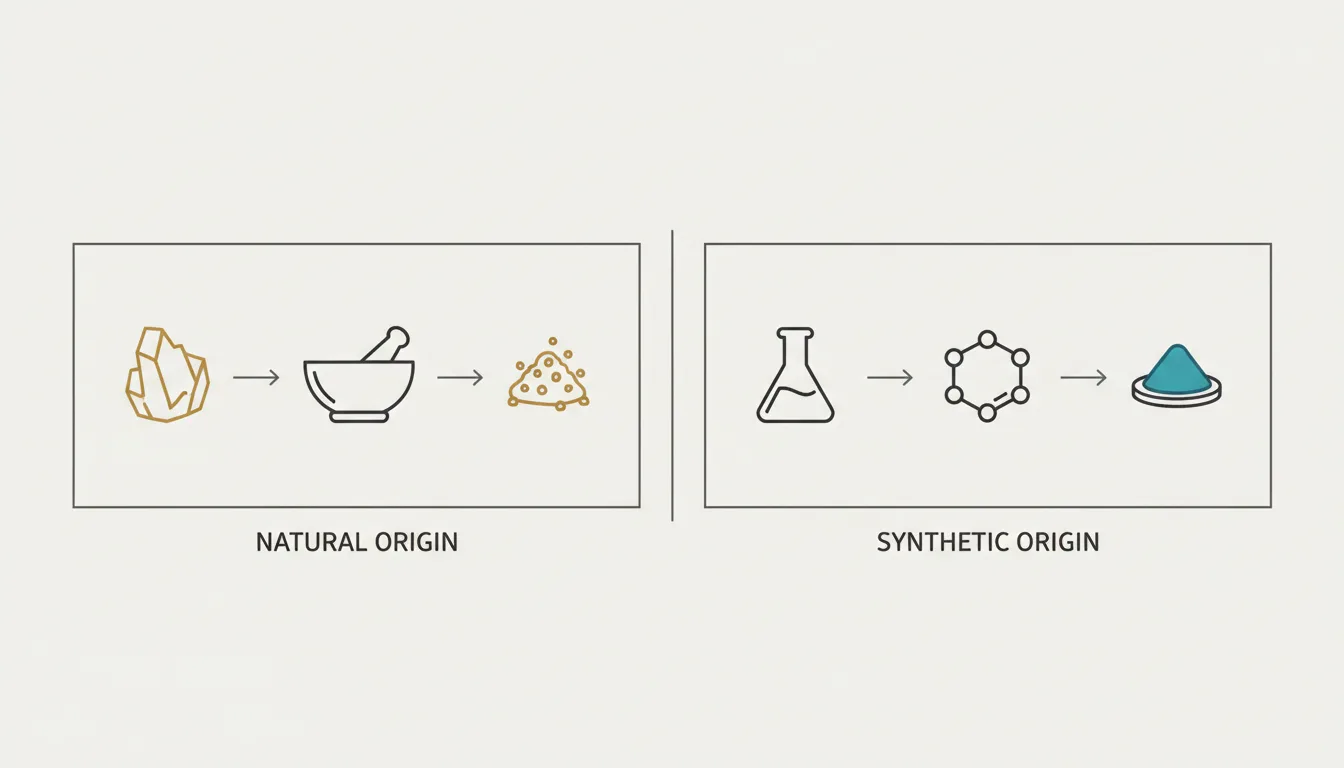
What actually separates a natural pigment from a synthetic one
The split isn't between "real color" and "fake color" — it's about where the raw material originates. According to paint manufacturer Golden Artist Colors, inorganic pigments come either from minerals mined directly from the earth (sienna, umber, ochre) or are manufactured synthetically from mineral sources, such as lab-produced iron oxide. Organic pigments, by contrast, are always synthetic — produced through complex carbon chemistry involving petroleum, coal tar, and natural gas.
So "natural" and "synthetic" describe how the colored powder came into being, not a hierarchy of quality. A natural ochre and a synthetic iron oxide can land on nearly identical earth-yellow tones to the eye — what differs is the road each one took to reach the tube.
From dug earth to lab formulas: a short history
Earth pigments — ochres above all — have been in the human palette for more than 40,000 years, according to paint manufacturer Gamblin: dug straight from the ground, ground down, and used with almost no processing. That natural availability, paired with solid lightfastness, is why they dominated painting for so long.
Blue tells a more extreme version of the same dependence on geography. Natural ultramarine came exclusively from lapis lazuli mined in the Badakhshan region of present-day Afghanistan, and it was among the most expensive pigments available to painters — reserved almost always for the most prestigious commissions, such as the Virgin's robe in religious painting. That changed in 1826, when French chemist Jean-Baptiste Guimet developed a method for manufacturing ultramarine synthetically, patented in 1828 — breaking a centuries-long monopoly held by geology and putting the color within reach of far more painters.
On the earth-pigment side, the push toward synthesis came from a different pressure: consistency. Gamblin notes that the commercial paint industry, from the late 18th century through the 19th, began demanding uniform color and texture from batch to batch — something mined mineral pigment, with its natural variation, doesn't guarantee on its own. That's how synthetic iron oxides (the so-called "Mars" colors) were born — more opaque and more production-stable than many natural ochres.
Does origin change how long a painting lasts?
Not by origin — by the individual pigment's rating. Lightfastness is measured on the ASTM scale, from I to V, according to manufacturer Liquitex: ASTM I means excellent stability (no perceptible change over 100 years), ASTM V means poor performance (visible change in two years or less). The test exposes paint to roughly 300 hours under a xenon-arc lamp — the rough equivalent of 100 years of studio light.
Liquitex is direct about what actually decides that rating: "some pigments are naturally more lightfast than others" — a matter of the specific molecule, not of whether the color came from a rock or a lab flask. There is synthetic organic pigment with excellent lightfastness, and there is natural pigment with excellent lightfastness too — ochres, historically, earned their place by being "not only lightfast, but widely available," Gamblin notes. What doesn't exist is a rule guaranteeing greater durability just because a pigment falls into one category or the other.
Does it change what a painting costs?
In raw-material cost, yes — and sometimes in the opposite direction from what intuition suggests. Paint manufacturers commonly price pigments in tiers, with rarer or more expensive-to-produce pigments costing more per tube regardless of whether they're natural or synthetic. In the specific case of natural ochres, Gamblin records a concrete data point: the once-rich deposits in Siena, Corsica, and Cyprus are now nearly mined out, which has already driven up cost and reduced the transparency of the natural ochres currently on the market — a function of geological scarcity, not fashion or branding.
But that's the cost of loose pigment powder, not the final price of a finished work. In a completed piece, raw material is a small fraction of what builds the value — scale, execution time, technique, series, and the studio's own production curve weigh far more than which type of pigment sits in any single layer.
How to tell which type of pigment is in a painting
To the naked eye, in most cases, there's no way to know for certain — very similar colors can come from completely different sources, like the natural ochre and synthetic iron oxide mentioned above. Reliable identification is lab work: according to the reference project Pigments through the Ages, spectroscopy techniques — Raman, FTIR, and X-ray fluorescence (XRF) — can pinpoint precisely which molecule is present in a paint layer, non-destructively, by comparing the resulting spectrum against a reference database of known pigments.
For someone acquiring contemporary art directly from a studio, lab analysis isn't the practical route — the assurance comes from the documentation that travels with the piece: technical sheet, dossier, and Certificate of Authenticity, where the studio itself states the materials used in that specific work.
From the studio
The studio's view: real gold beside synthetic pigment
Almost everything that leaves this studio starts on an acrylic ground — synthetic pigment, stable, consistent from batch to batch, for the exact reasons the industry went looking for it in the 19th century. But in a handful of pieces I bring in a material that has nothing synthetic about it: real gold leaf, a mineral metal, not something built in a lab. That's the case with Quartz Seam, a canvas in the Terra & Ether series, where thin lines of gold cut across fields of dusty rose and charcoal grey — not as ornament, but marking the exact point where one layer of color meets the next.
I don't reach for gold because it's "nobler" than acrylic. I reach for it because the metal throws light in a way no synthetic pigment reproduces, and that physically changes how the piece reads across a room over the course of a day. It's the same logic behind any material choice in painting: natural or synthetic isn't a hierarchy, it's a toolkit — each one solves a different visual problem, and the finished piece is decided by what the surface asks for, not by where the powder came from.
Frequently asked
Are natural pigments better than synthetic ones?
Not as a general rule. A pigment's quality and durability depend on its individual lightfastness rating on the ASTM scale, from I to V, not on whether it came from ground rock or a lab process. There are excellent natural pigments and weak ones, exactly as there are excellent and weak synthetic pigments — origin alone doesn't decide it.
Do synthetic pigments fade faster than natural ones?
Not necessarily. Several synthetic organic pigments have excellent lightfastness and are used specifically for that reason. At the same time, natural earth pigments like ochres have been used for millennia because they're both available and light-resistant. What determines how fast a color fades is the specific pigment molecule and its ASTM rating — not whether it's natural or synthetic.
Do contemporary painters still use natural pigments?
Yes. Earth pigments — ochres, siennas, umbers — remain in use today, including through paint manufacturers that keep dedicated lines of natural mineral pigment. What's changed is that the richest historic deposits, like those in Siena, Corsica, and Cyprus, are now nearly exhausted, which has been driving up cost and reducing the transparency of the natural ochres available on the market, according to manufacturer Gamblin.
Do natural pigments make a painting more expensive?
In raw-material cost, they can — rarer natural pigments cost more, and the scarcity of historic ochre deposits has pushed that cost up in recent years. But pigment powder is a small fraction of what sets the price of a finished work. Scale, execution time, technique, and the studio's own production curve matter far more than the specific pigment used in a given layer.
How can you tell what type of pigment was used in a painting?
With certainty, only in a lab: spectroscopy techniques like Raman, FTIR, and X-ray fluorescence (XRF) identify a pigment's exact molecule non-destructively, by comparing the sample's spectrum against a database of known pigments. The naked eye can't guarantee it — very similar colors can come from very different sources. When buying directly from a studio, reliable information comes from the artwork's documentation, not visual inspection.
Sources
- Golden Artist Colors — 2026-08-21
- Gamblin Artists Colors — 2026-08-21
- Rhiannon Piper Conservation — 2026-08-21
- Liquitex — 2026-08-21
- Pigments through the Ages (WebExhibits) — 2026-08-21
Want to know which materials go into each studio piece?
We can walk you through the pigment, ground, and finish behind any work — including where real gold enters, as in Quartz Seam — before you decide on an acquisition. International shipping and full documentation (Archive ID, Certificate of Authenticity) are included with every piece.
Talk to the studio on WhatsApp
Published on